
Willpower Isn’t the Problem
You set the intention. You made the plan. You promised yourself that this week, you wouldn’t snap at your partner, you wouldn’t doom-scroll until midnight, and you wouldn’t eat your stress.
And then, Wednesday hit. The pressure mounted, the plan crumbled, and you found yourself back in the old habits, wondering: What is wrong with me? Why don’t I have enough willpower to stick with my goals?
Here’s the Truth: Nothing is wrong with you, and willpower isn’t the problem. The problem is that you are trying to use a mental tool to solve a physiological problem.
Why Trying Harder Backfires
We tend to treat willpower like a limitless fuel source, assuming that if we just push harder, we can override our stress.
But let’s reframe this by looking at the body. Imagine a bodybuilder who focuses exclusively on bicep curls. Day after day, the bodybuilder contracts that muscle, building it up, making it hard and tight. But the biceps muscle is never stretched, and the opposing muscle, the triceps, is never strengthened.
Eventually, the arm becomes stuck in a flexed position. It literally cannot straighten.
If you asked the bodybuilder to just try harder to straighten the arm, it can’t happen. Not because the person is lazy, but because chronic tension has created a functional limitation.
Your nervous system works the same way. When you spend years in high-functioning survival mode—pushing, performing, perfecting—you are essentially keeping your stress response flexed. No amount of willpower can force a flexed system to relax. An entirely different approach is required.
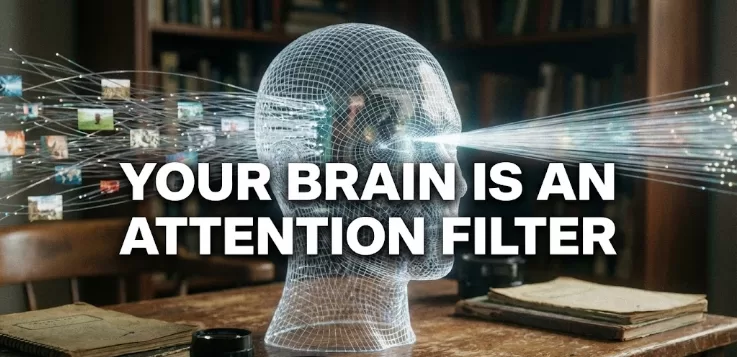
Your Brain is an Attention Filter
To understand why you can’t just think your way out of stress, we have to look at the reticular activating system (RAS).
Think of the RAS as a bouncer at the door of your brain. Its job is to filter the millions of bits of data coming at you and decide what gets through to your conscious mind.
-
When you are regulated (safe), the bouncer is relaxed. He lets in creativity, humor, empathy, new ideas, and the ability to see the big picture.
-
When you are dysregulated (stressed), the bouncer goes into lockdown. He perceives a threat. To keep you safe, he blocks out anything unnecessary—like joy, patience, or creative problem solving—and only lets in survival data.
This is why, when you are stressed, you can only see the problems. You literally cannot perceive the solutions.
You aren’t choosing to be negative. You are looking at the world through a safety filter that has been welded shut.
Sensing Your Way to Safety
This is where the social self—the part of you that performs—hits a wall. It tries to talk the bouncer into opening the door. It tries to analyze the stress away.
But the RAS doesn’t speak English. It speaks somatic (body) language.
The only way to broaden that filter—to allow vitality and calm back into your experience—is to signal safety directly to the body. You do this not by thinking, but by sensing.
-
Feel the weight of your feet on the floor.
-
Notice the support of the chair under your legs.
-
Extend the exhale of your breath.
These tiny data points bypass the skeptical brain and go straight to the nervous system, telling it: You are safe now. You can straighten the arm. You can open the door.
Stop Forcing, Start Flowing
If you are tired of the cycle of powering through the week and crashing on the weekend, it’s time to stop relying on willpower.
You don’t need more discipline. You need a better baseline.
By learning to regulate your nervous system, you stop fighting against your own biology. You widen the filter. And suddenly, the patience, focus, and joy you were trying so hard to find are just . . . there.
Ready to reset your filter?
Step 1: Start with my free Somatic Toolkit—15 short, science-backed lessons to help you shift from survival mode to vitality in minutes a day. Access the Toolkit HERE.
Step 2: Ready for the deep dive? If you want to master these tools and rewire your stress response for good, join the next 12-week cohort of my BodyMind IntelliSense Transformation System. Learn more about the program HERE.